Established hubs.
Emerging possibilities.
Bring regional infrastructure, market context and source data into a shared inventory, extending the discovery ambition beyond data-rich markets.
Site intelligence. Evidenced.
The potential of a site is only the beginning. Cooper is connecting the intelligence, evidence and diligence that help an opportunity move forward.
Explore the platformProduct vision An evidence-led approach to data-centre development
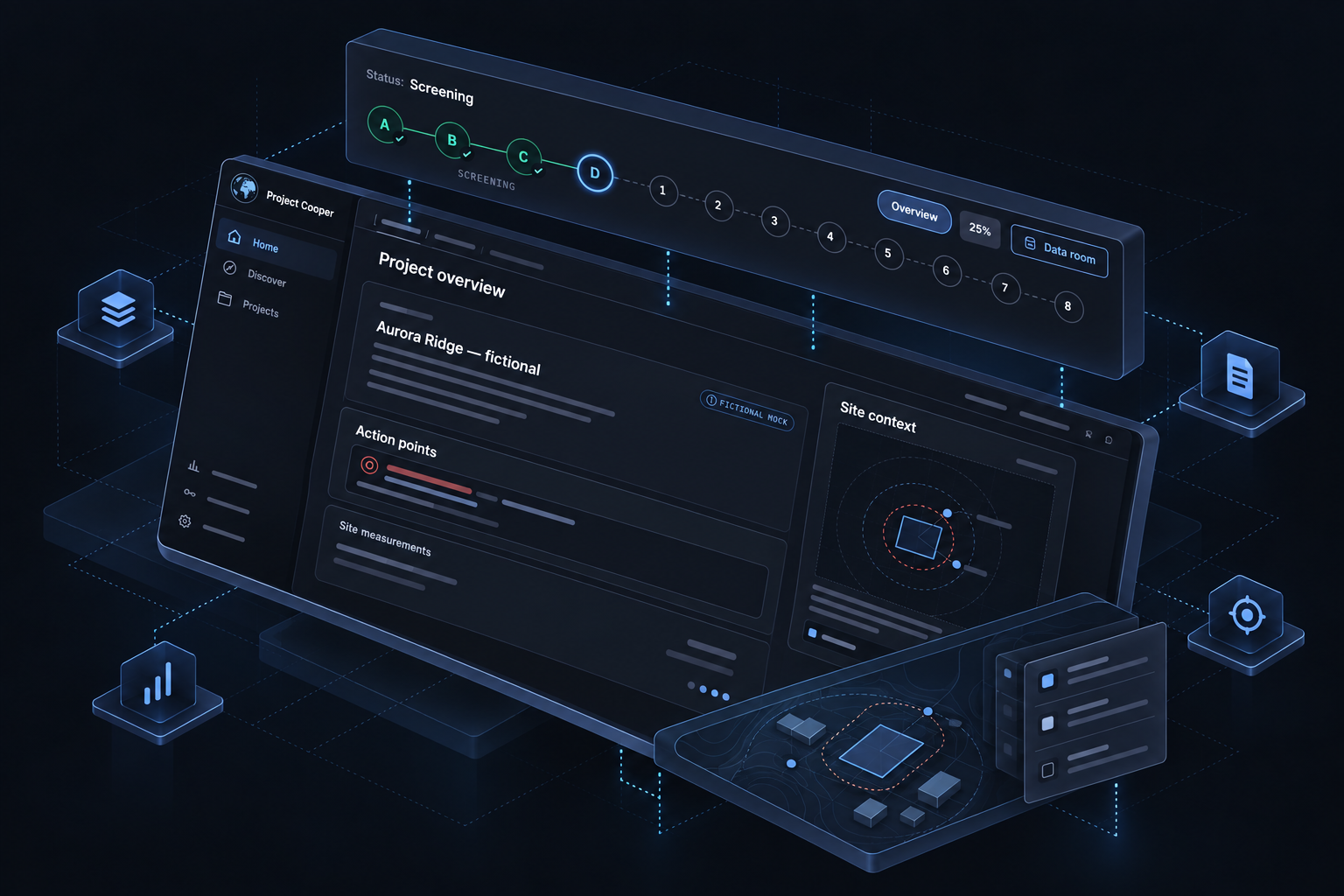
A shared language for site readiness
The development reality
Taking a powered-land site from selection to sale takes 18 to 24 months. Land, power, permits, packaging and buyers run as overlapping workstreams against six gates, with power setting the pace.
No single task is the hard part. The hard part is keeping every task accurate, protected and in the right order while the calendar keeps moving.
Five pressures on every project
Once capacity is reserved, the grid operator, the authorities and early buyers all come back with questions at the same time. The answers sit in emails, adviser reports and spreadsheets.
ExampleA prospective buyer asks for the current power position during go-to-market. Answering means chasing three advisers and rebuilding the timeline by hand. That takes days when it should take hours.
68 budgeted work lines, each fed by a different source: land registers, grid studies, geotechnical surveys, legal opinions. Figures drift every time they are copied from one document to the next.
ExampleIn one recent partnership deck, the land right was 99 years on one slide and capped at 40 years by law on another. The land and power budgets also differed between two slides of the same pack.
Buyer engagement starts at month 9, well before permits are final. From then on, landowners, partners, advisers and bidders each need a different view of the same sensitive material.
ExampleA bidder should see the grid agreement summary, but not the land partner's payment terms or the competing offers. Shared folders and email attachments make that line hard to hold.
The investment pack has to survive a buyer's due diligence. Each number needs checking against its source and against an independent benchmark before anyone else runs the same check.
ExampleIn one data room we reviewed, the deck said 2,280 acres, the executive summary said 1,300 and the sponsor's written answers said about 1,200. The permits sold as "shovel-ready" covered a different part of the site from the land offered for the data centre. Every figure came from the sponsor's own documents; nobody had checked them against each other.
Five stages overlap against six gates, and power is the critical path. A slip on the grid agreement pushes back permits, the pack and the sale. What matters is knowing what to do next and what it unlocks.
ExampleOpening buyer engagement at capacity reservation (month 9), instead of waiting for final permits, takes about four months off the time to close: from month 24 to month 20.
Months follow Cooper's indicative lifecycle template. Each market stretches or compresses them, and some work items apply only where local rules require them. Examples come from real project material with names removed.
The connected opportunity
Power, land, connectivity, water and permissions each tell part of the story. Cooper brings the questions together: how suitable is this site, how strong is the evidence, and what should happen next?
Find the potential.
Explore locations, infrastructure and the regional context.
Candidate opportunitySee the whole picture.
Bring suitability, confidence and evidence gaps into view.
Informed assessmentBuild the evidence.
Connect sources, resolve questions and coordinate follow-ups.
Traceable findingsMake the call.
Review the evidence and record an accountable human decision.
Recorded rationaleCarry the story forward.
Assemble the evidence, conditions and next steps for review.
Reviewable packageEvidence travels with every step.
Sources · Confidence · Gaps · DecisionsGlobal ambition. Regional intelligence.
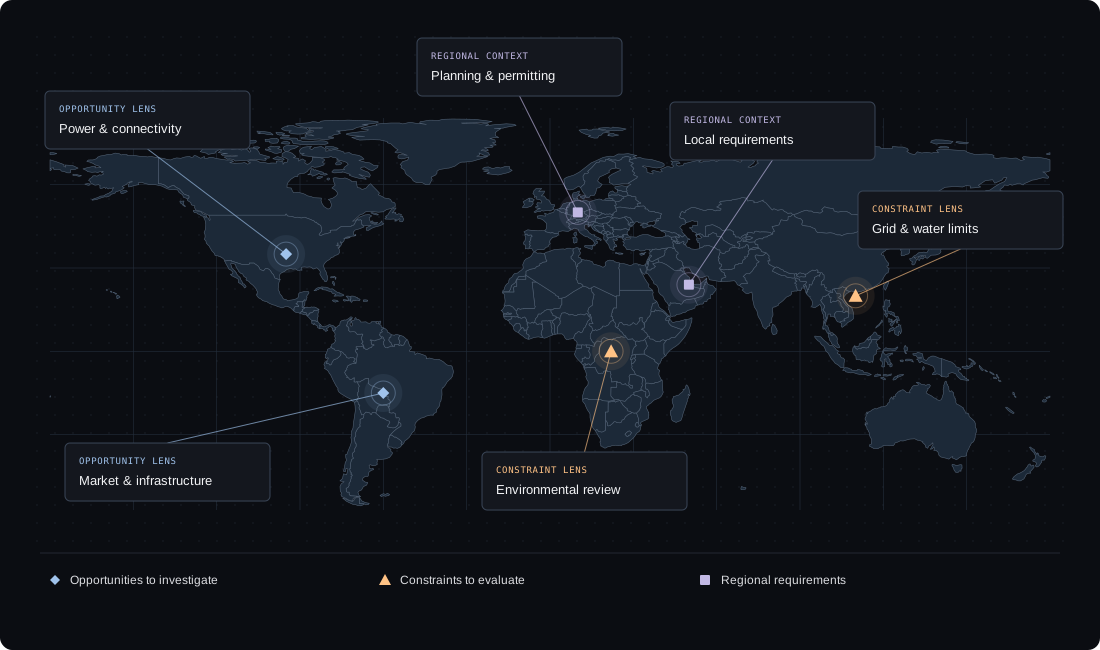
Cooper is being built around a global data inventory: connecting established regions and emerging markets with the local understanding each opportunity demands.
Regional intelligence, regulatory requirements and environmental compliance evidence come together in one consistent workflow — so international teams can work across borders with the context to make informed decisions.
01 / GLOBAL SIGNALS
Real-time where available.
Scheduled and published updates
elsewhere.
02 / INTELLIGENCE LAYERS
Working framework · Validate, contextualise and retain provenance.
03 / CONNECTED INTELLIGENCE
cooper.
A growing intelligence base.
A clearer view of what
changed.
Bring regional infrastructure, market context and source data into a shared inventory, extending the discovery ambition beyond data-rich markets.
Connect jurisdiction-specific planning, permitting and environmental compliance requirements with land, power, water, connectivity and other local constraints.
Give international customers a seamless workflow across regions while keeping source quality, local interpretation and outstanding evidence visible.
Global inventory and regional adaptation are the product direction. The current implementation uses the US as its reference; regional coverage, source validation and jurisdiction packs remain to be delivered. Uneven data availability stays explicit.
Inside Cooper
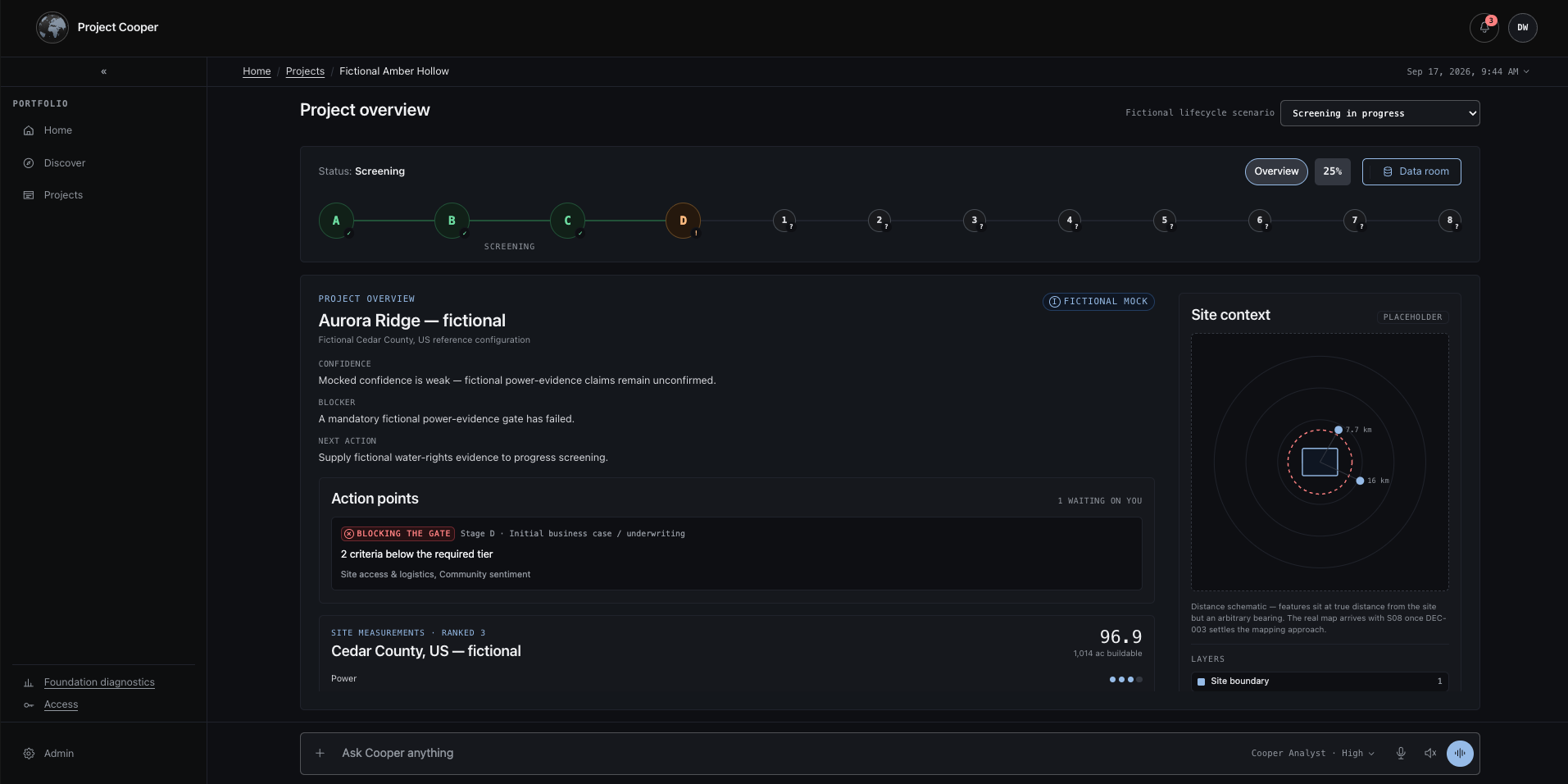
Actual screens from the Cooper prototype. Explore the project workspace, then follow the evidence into the data room.
 Open original screen ↗
Lifecycle, evidence and outstanding work.
From information to understanding
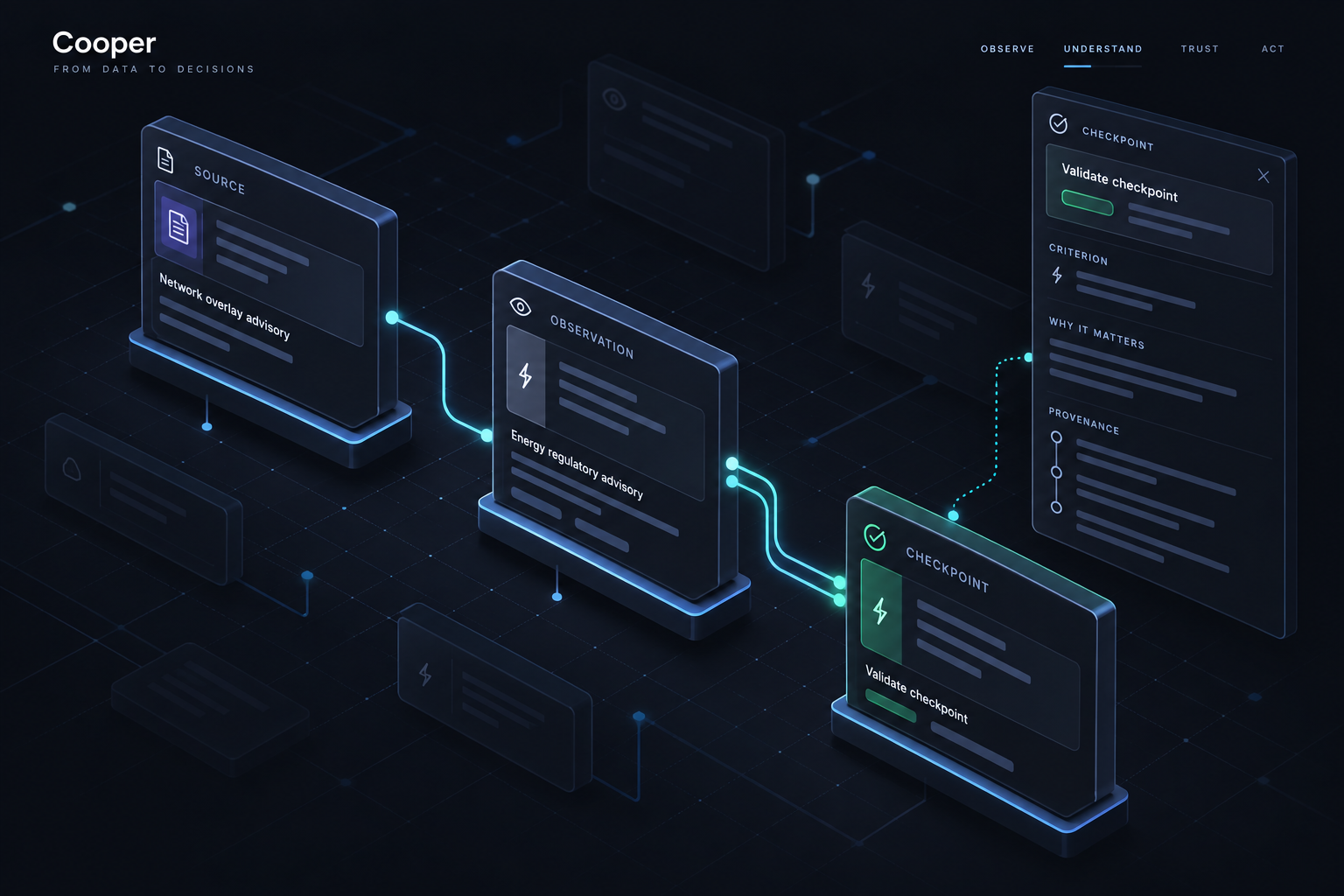
Follow a claim back to its source. Understand its confidence, freshness and history. See the gaps that a favourable suitability score can leave unanswered.
THE OUTCOMEA more transparent basis for the next decision.
From uncertainty to action
Turn the question “what is missing?” into a clear view of the work ahead. Connect activities, evidence and human checkpoints as development workstreams progress.
THE OUTCOMEA clearer route through diligence.
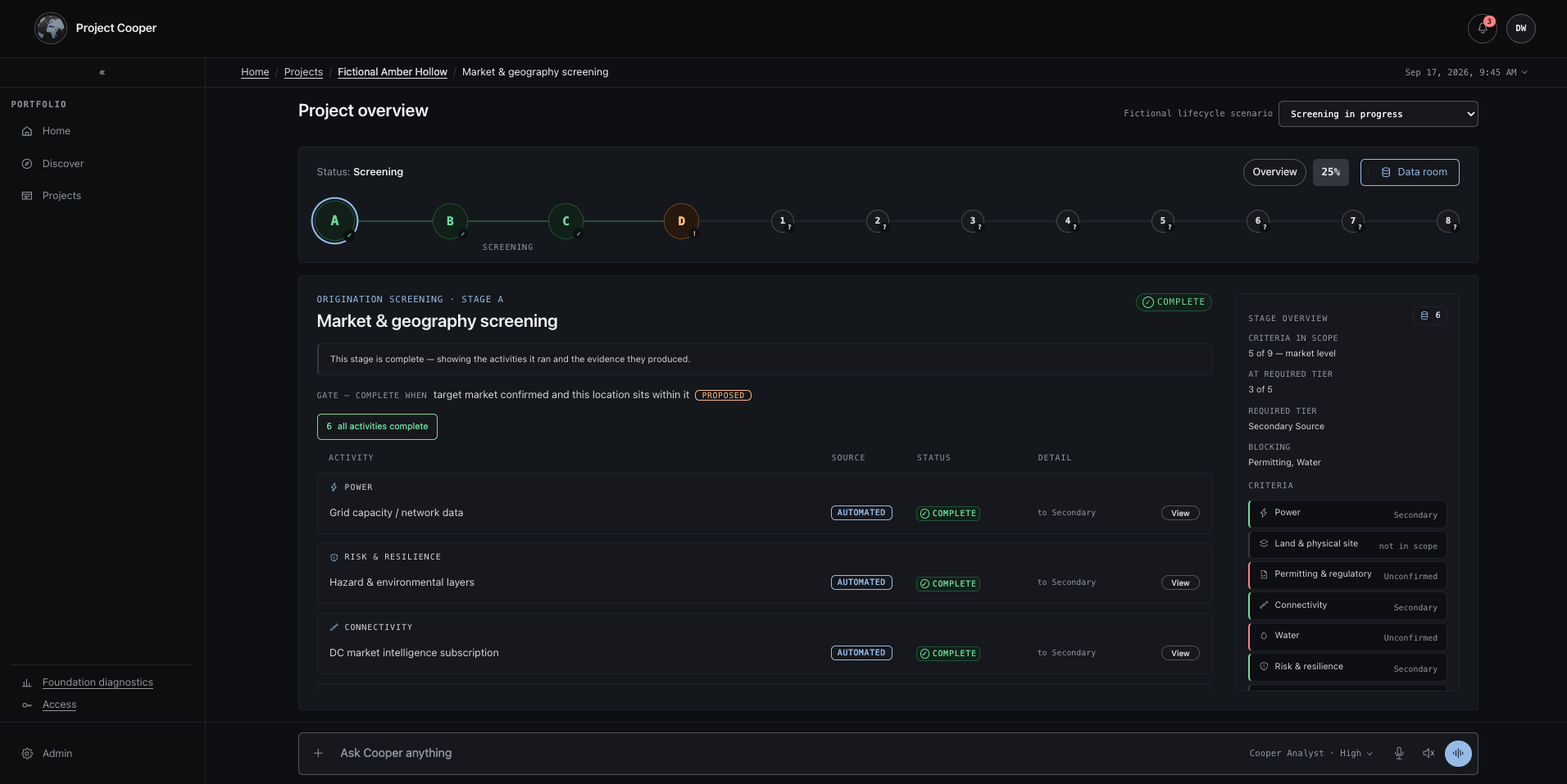 Open original screen ↗
One workspace for the stage.
From diligence to the deal conversation
A structured Virtual Data Room connects what the project holds with what its conclusions depend on. The vision for versioned Site Packs carries that context into adviser and investment review.
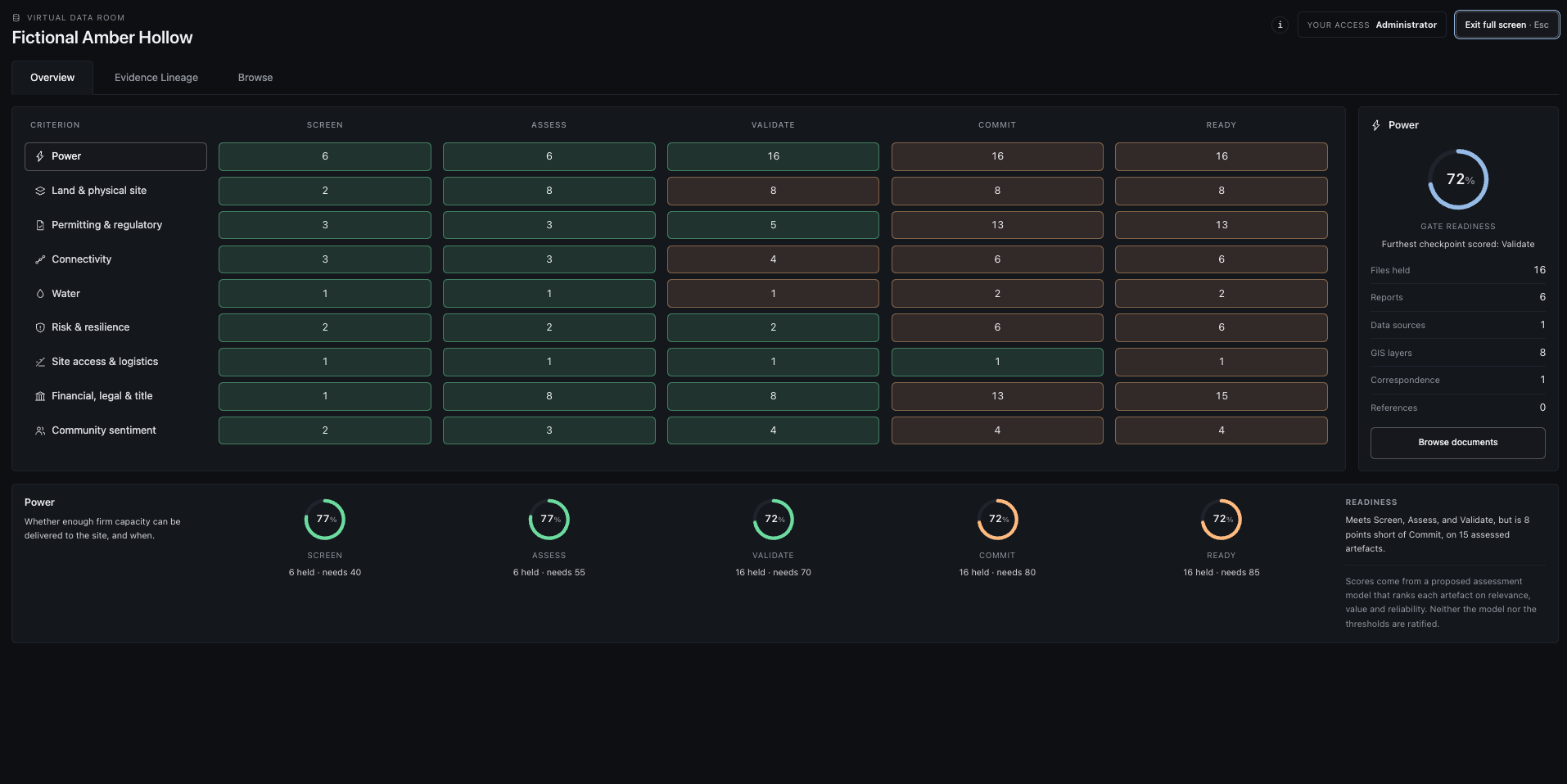 Evidence readiness
Coverage and conditions, together.
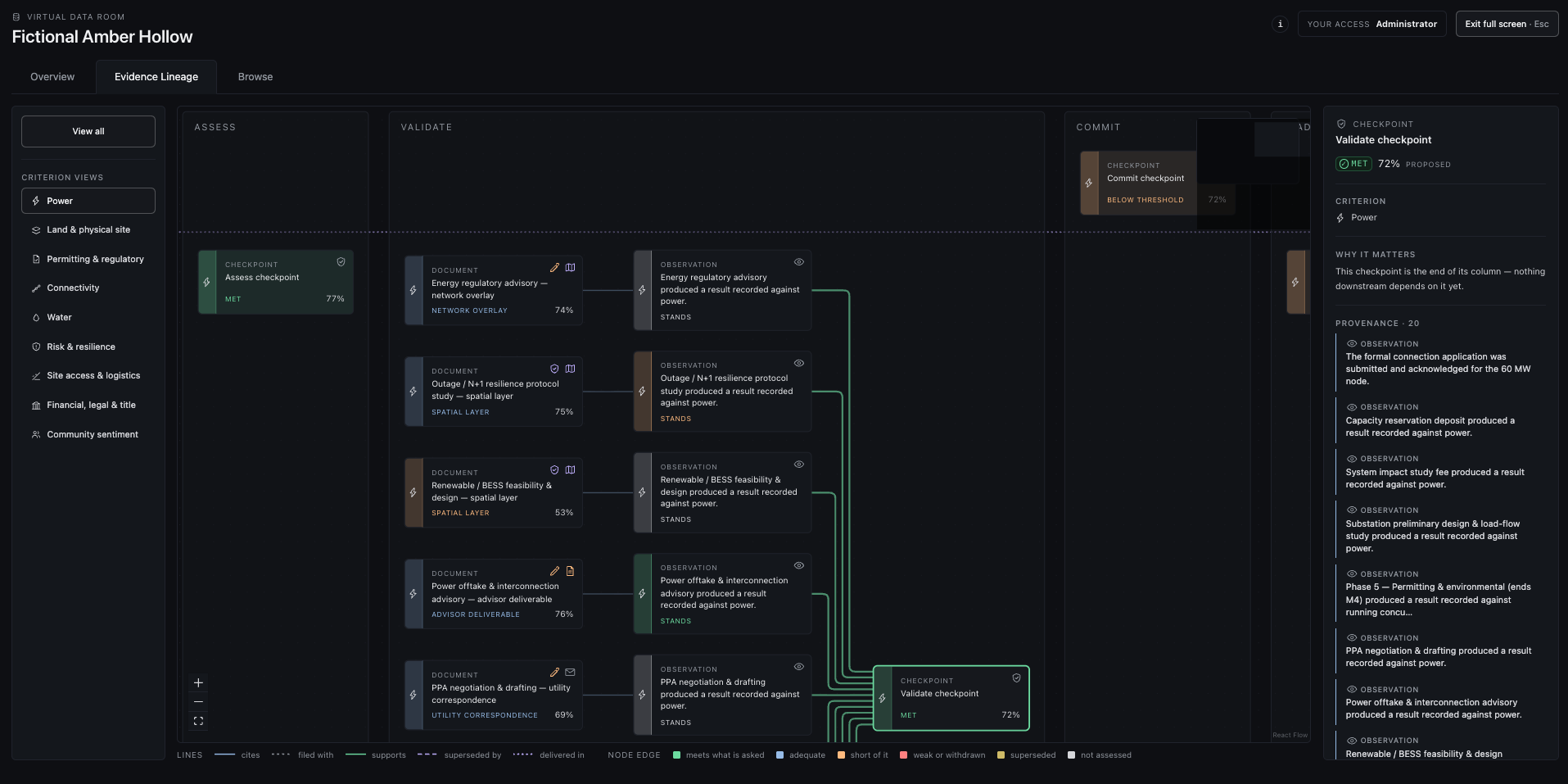 Evidence lineage
Follow the basis of a conclusion.
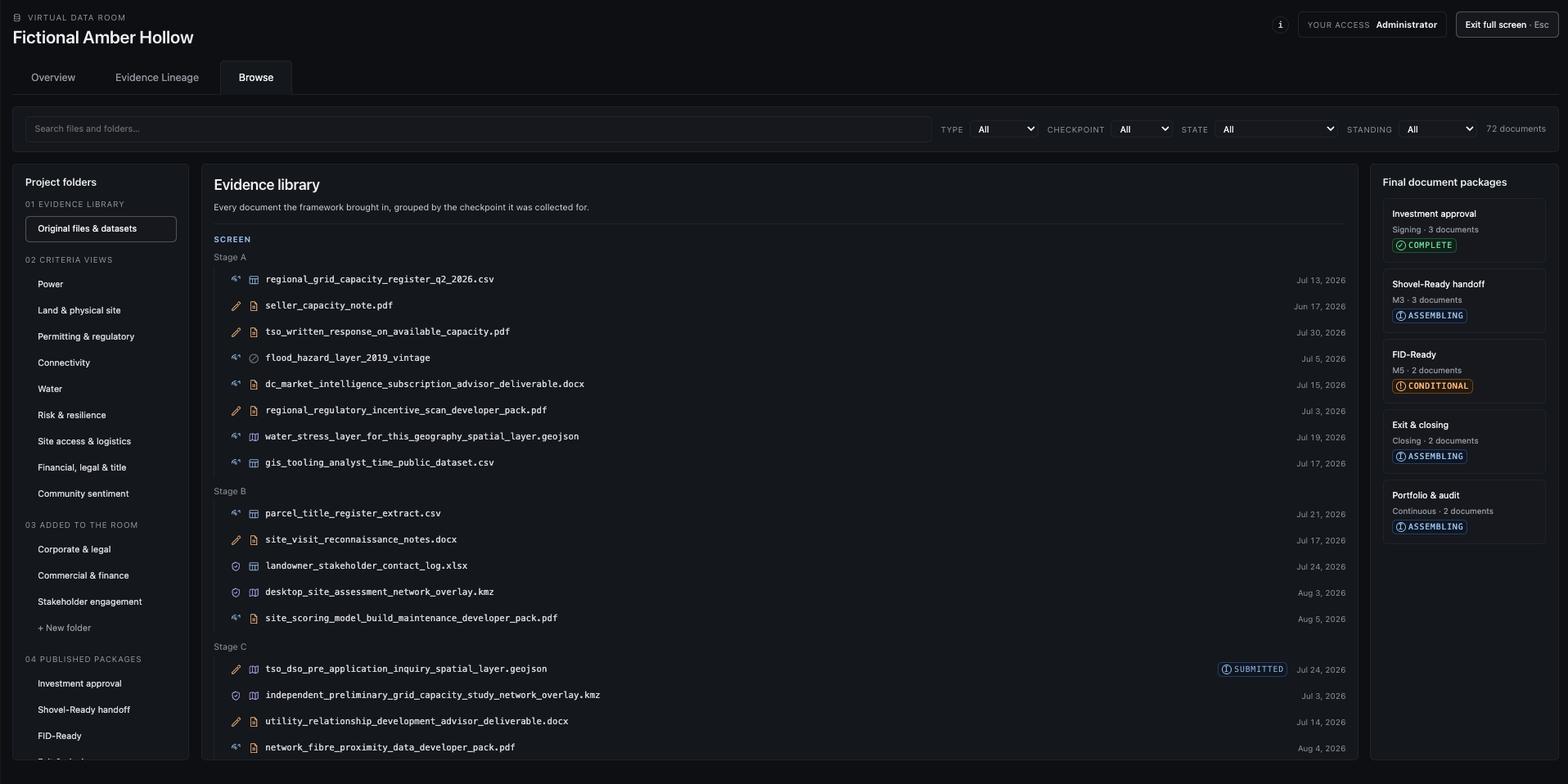 A structured data room
Find the material behind the opportunity.
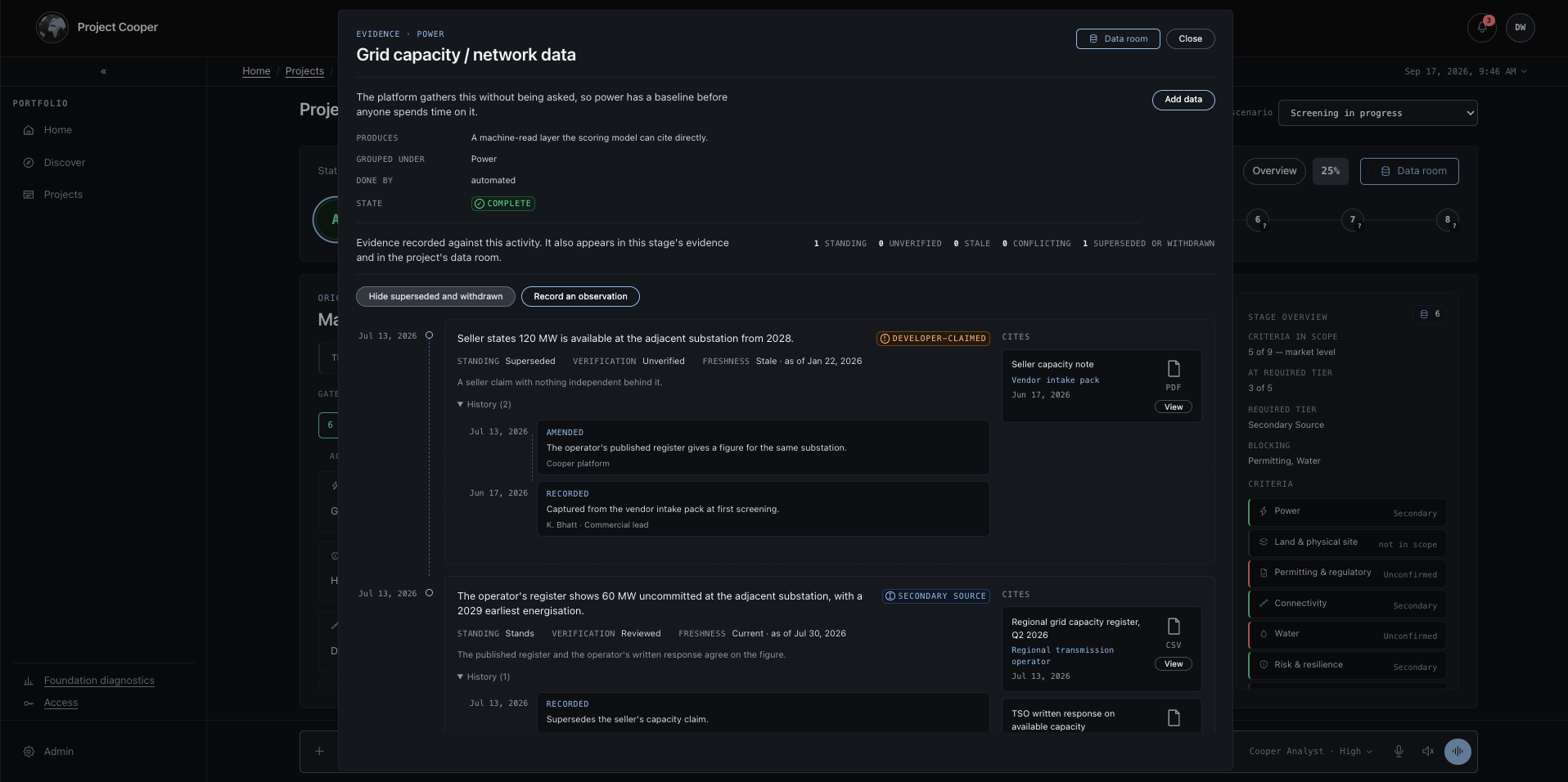 The record of change
Keep the earlier claim and its context.
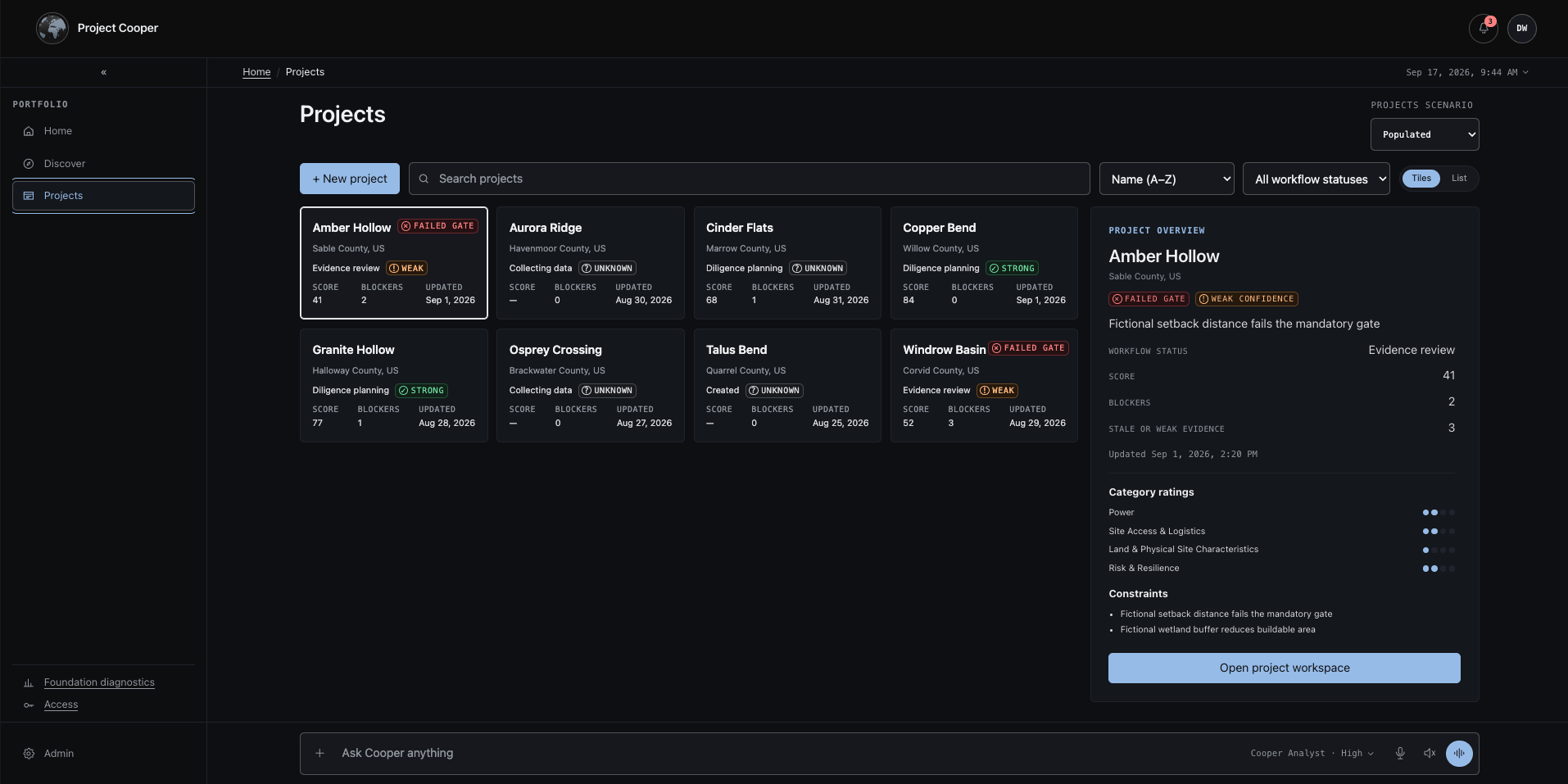 Portfolio perspective
Potential, confidence and blockers.
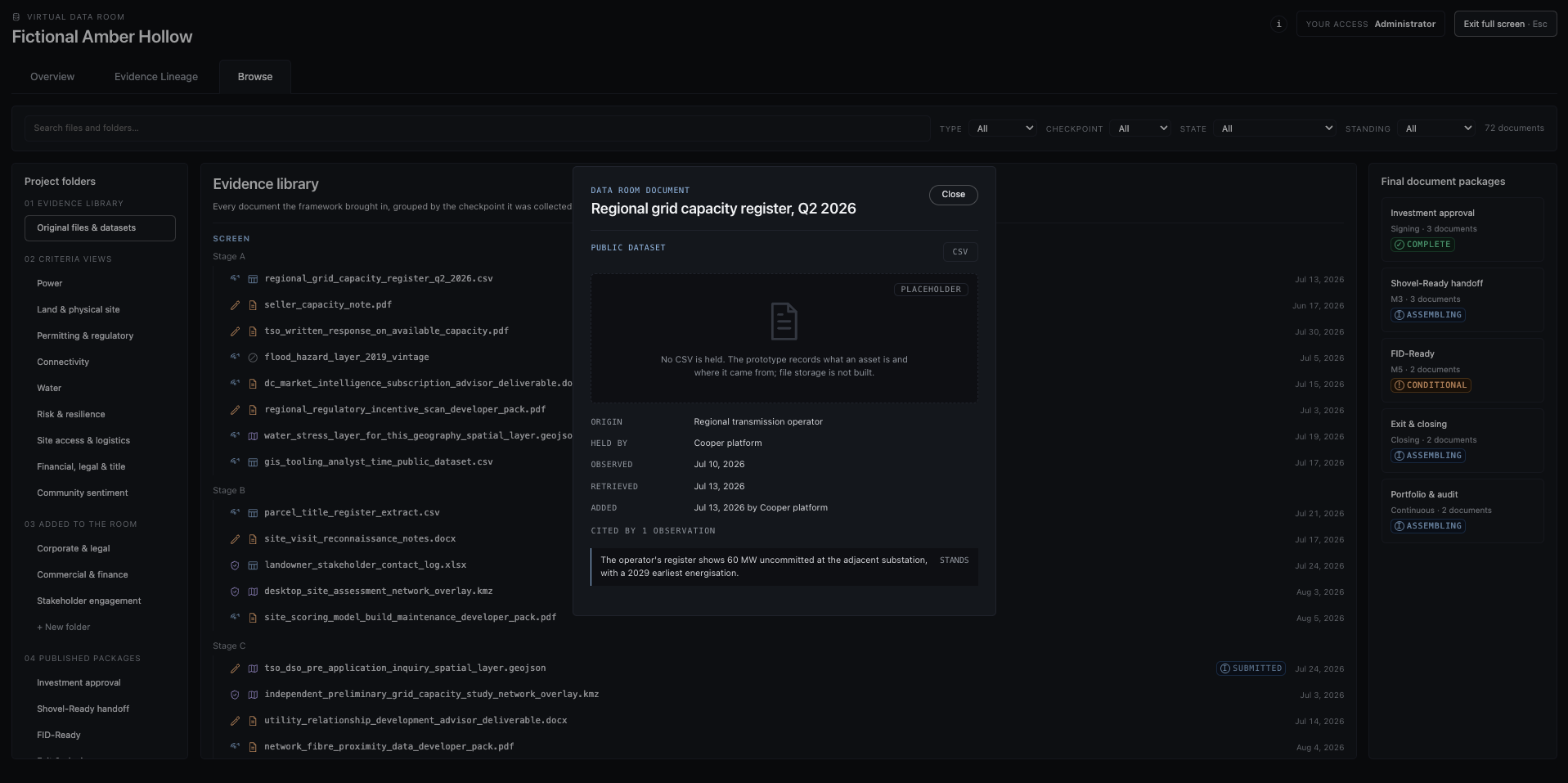 Source provenance
Where it came from, and what relies on it.
Product captures use fictional data. Readiness percentages and thresholds are proposed; the file viewer remains a placeholder. Open any screen for its original detail.
Browse the project's evidence and supporting records.
Inspect how sources support observations and checkpoints.
Keep assumptions, conditions and outstanding work visible.
Personalised agents / Planned capability
A persistent AI footer brings assistance into the flow of work. Cooper's vision is for agents that understand the project, respect your permissions and adapt to your preferences — helping you find answers, prepare outputs and move work forward.
Less time assembling context. More time understanding what matters and deciding what happens next.
A new utility response could change the basis of the power assessment. Review it against the earlier claim before drawing a conclusion.
Suggested follow-upPrepare an evidence-review task for your approval.
Awaiting reviewAsk about Cooper or a project. Receive context-aware explanations with source references, visible uncertainty and information limited to your access.
Prepare concise summaries and polished report drafts, tailored to your preferred detail and audience. Keep citations, gaps and assumptions available for review.
Delegate permitted workflow tasks, such as preparing follow-ups or updating an action. Review proposed changes, approve where required and see the recorded outcome.
Surface relevant project changes, their potential impact and suggested next steps. Choose what to follow and when to be notified, or ask for a brief whenever you need it.
A deliberate path to trusted automation
The ambition is secure assistance that earns trust through evidence, reliable execution and a clear record of what happened. Access and actions must be checked against your current permissions; preferences never expand that authority. Human approvals and decision gates remain authoritative, with failures and uncertainty made visible.
The footer is demonstrated in the prototype. Personalisation, permission-scoped agent services, report generation, delegated actions and change notifications remain to be implemented and validated.
Different perspectives. A clearer picture.
Each participant asks different questions. Cooper's ambition is a shared evidence framework, with information available through deliberately authorised access.
“What could this site become?”
Present a site's opportunity, the evidence behind it and the conditions that need investigation.
“What will it take to deliver?”
Connect technical fit and constraints to the diligence required to advance a location.
“What supports the investment case?”
Understand the claims, outstanding uncertainties and evidence behind readiness milestones.
“Does it fit our requirements?”
Assess how an opportunity aligns with workload, infrastructure and delivery requirements.
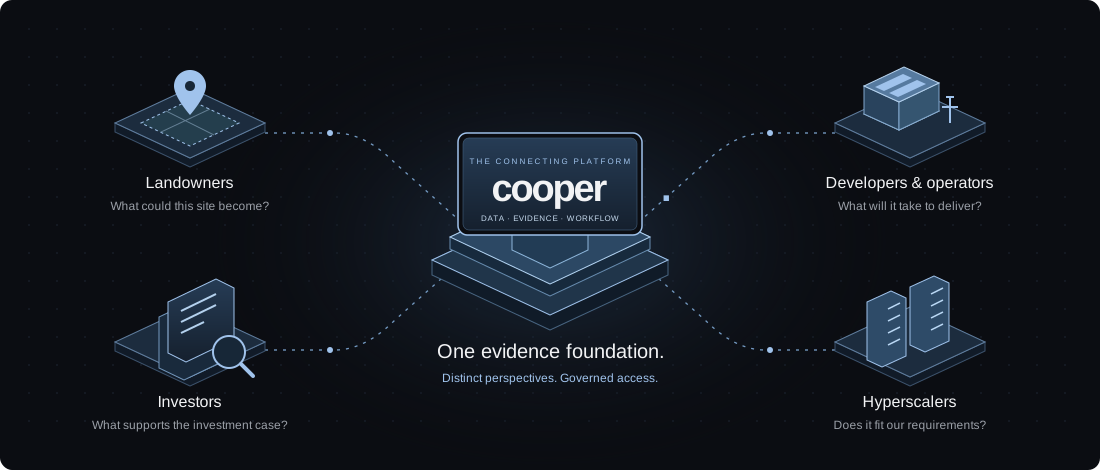
Hover or select a perspective to see its connection.
With a role for technical, environmental, planning and legal advisers — and potential participation by utilities, infrastructure providers and authorities.
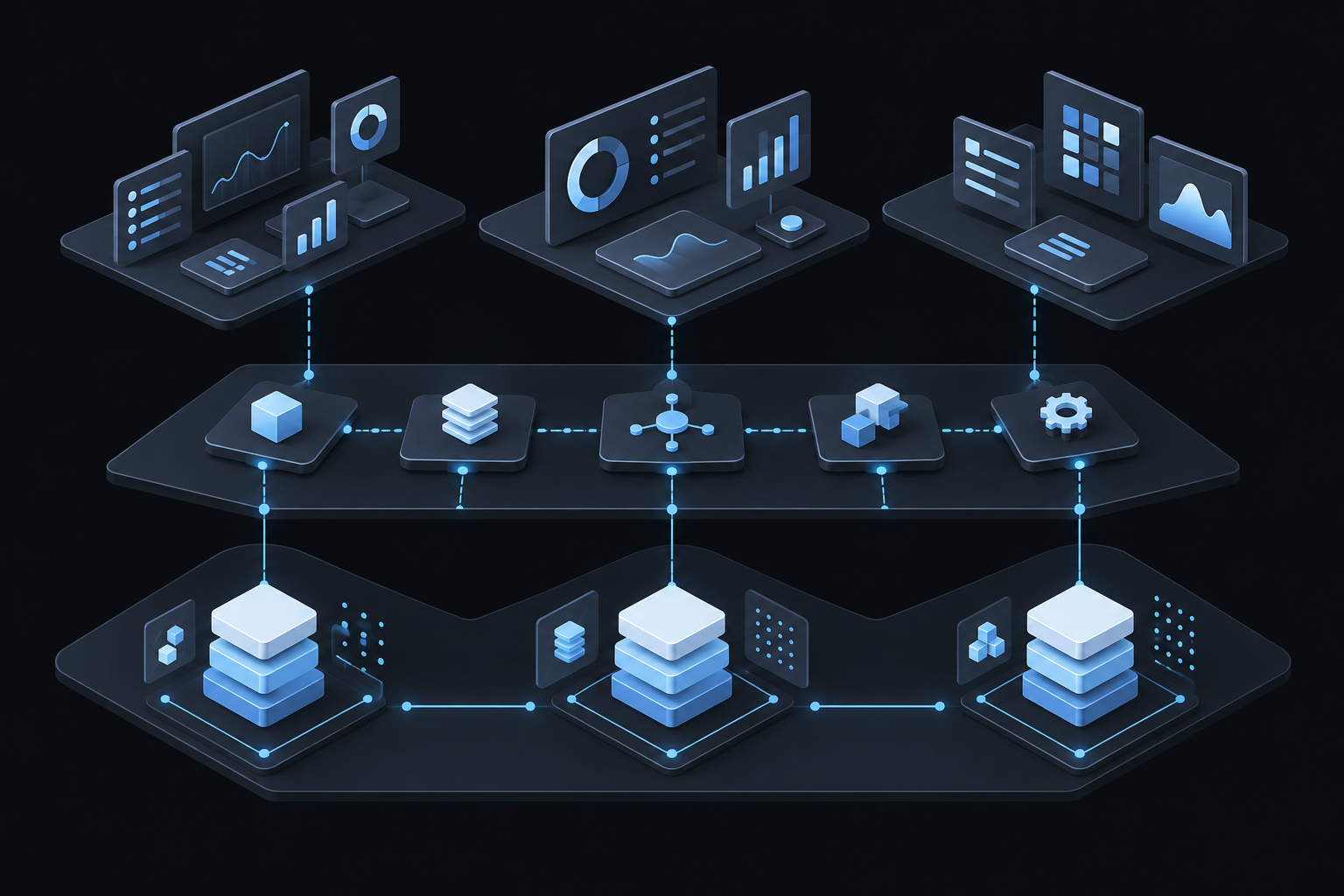
An enterprise platform vision
A monolithic starting point, with a vision for bounded modules, feature-flagged delivery and multiple organisations working within clear data and access boundaries.
The architecture direction
Logical boundaries, with deployment separation when scale, ownership or security requires it.
Stakeholder workspaces and interaction
Authorised operations and workflow state
Connectors and observable background jobs
Bronze → Silver → Gold, accessed through APIs
Transactional state and controlled object storage
Trust is an operating discipline
Least-privilege access, tenant and project boundaries, managed secrets and controlled document retrieval.
Visible job progress, source health, correlated telemetry, alerting and rehearsed recovery.
Versioned models, thresholds and workflows, with controlled feature rollout for different needs.
Attributable changes and decisions, retained evidence history, and deliberate classification and retention.
Our security & compliance goals
Protecting customer information is central to Cooper's ambition. We are targeting recognised assurance and security frameworks, with responsible data handling designed into the platform from the start.
Target independent assurance over relevant service controls, supported by documented evidence of how those controls operate.
Build a risk-based information security management system, with clear ownership, maintained controls and continual improvement.
Design for applicable data-protection obligations: privacy by design, data minimisation, individual rights and deliberate retention.
Where we are. Where we are going.
DEMONSTRATED
Portfolio and stage workspaces, evidence recording, the data room and interactive lineage — demonstrated with fictional data. User and role administration is database-backed.
PLANNED & VISION
Global data inventory, live Discovery integration, production evidence services, validated assessments, Site Packs and personalised agents. Multi-tenancy, feature flags and wider enterprise controls remain to be delivered.
Readiness is specific to the evidence, use case and checkpoint. Cooper supports accountable expert decisions; it does not certify utility capacity, permits, financing or investment outcomes. Illustrations are conceptual. Benefits remain hypotheses to validate through pilots.
The Cooper ambition